

A breakthrough in solid-state battery design could eliminate key barriers to electric vehicle performance, making future EVs safer, more efficient, and longer-lasting.
This article was originally published by Future Timeline.
The adoption of electric vehicles (EVs) is accelerating worldwide, driven by advances in technology and growing consumer interest in sustainable transportation. However, current lithium-ion batteries, which power all modern EVs, still face critical challenges. High costs, limited driving range, and long charging times remain the biggest obstacles to widespread adoption, with concerns around battery lifespan and safety also playing a role.
This is where the next generation of batteries comes into play. Solid-state batteries – seen as a game-changer for the EV industry – promise to address many of these issues. By replacing the flammable liquid electrolyte with a solid one, these could offer significant improvements in efficiency, energy density, and safety. Despite the potential, the development of solid-state batteries has been slowed by technical hurdles, particularly the resistance that occurs where the solid electrolyte meets the battery’s electrodes. This resistance can limit its ability to deliver power effectively.
Now, researchers at McGill University have made a breakthrough that could overcome one of the most persistent challenges. Their new and innovative design uses a porous ceramic membrane, filled with a small amount of polymer, to eliminate interfacial resistance and allow lithium ions to flow more freely.
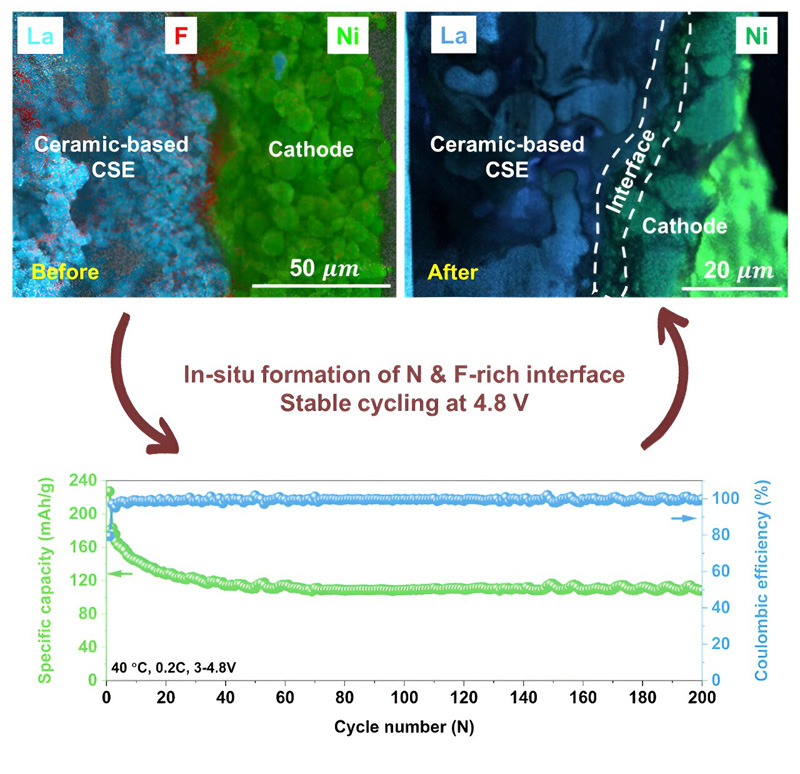
“This not only improves the battery’s performance but also creates a stable interface for high-voltage operation – one of the industry’s key goals,” explains Professor George Demopoulos, from the Department of Materials Engineering at McGill, who led the research.
Current lithium-ion battery cells typically operate at 3.6V to 3.7V, with a maximum of 4.2V before risking degradation. By contrast, the solid-state battery developed at McGill demonstrated remarkable stability at voltages as high as 4.8V without significant degradation. This ability to handle higher voltages safely is critical for extending the range and longevity of electric vehicle batteries. The researchers’ tests showed that the batteries can withstand over 200 charging cycles while retaining high energy density. While this is an early-stage result, further development and testing could match or exceed current lithium-ion battery cells, which are typically in the range of 1,000 to 2,000 cycles.
The team’s prototype design achieved an energy density of 398 Wh/kg – surpassing current industry targets, including the US Advanced Battery Consortium’s goal of 350 Wh/kg for high-performance EV batteries. This breakthrough suggests that future EVs powered by these solid-state batteries could travel further on a single charge while reducing the overall weight of the vehicle.
The research appears this month in the journal Cell Reports Physical Science. “This discovery brings us closer to building the next generation of safer and more efficient batteries for electric vehicles,” added Senhao Wang, first author on the study and a PhD graduate.