
Weight loss drugs have surged in popularity in recent years, transforming the pharmaceutical landscape. Companies leading the charge in GLP-1 development are reaping massive financial gains and wielding growing influence.
This article was written by Julia Wendling and originally published by Visual Capitalist.
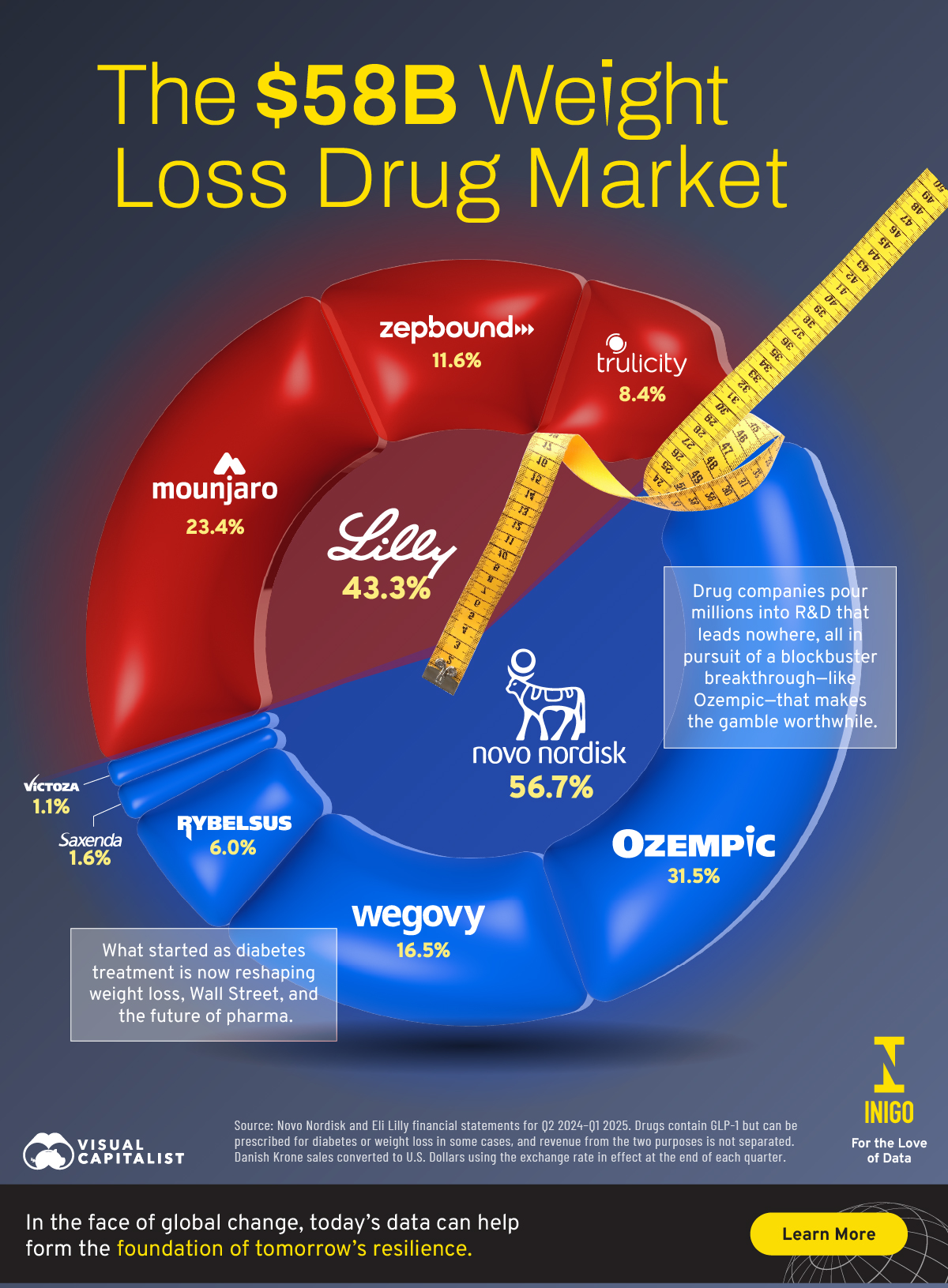
This visualization, created in partnership with Inigo Insurance, highlights the top brands dominating the $58 billion weight loss drug market—and the powerhouse companies driving their success.
What Are GLP-1 Drugs?
GLP-1 drugs have dominated headlines in recent years—but what exactly are they?
These medications mimic the hormone glucagon-like peptide-1, which helps regulate blood sugar and appetite. Originally developed to treat type 2 diabetes, they have become popular for weight loss because they slow digestion, reduce hunger, and promote feelings of fullness.
Ozempic, Mounjaro, Wegovy, and More Weight Loss Brands
In the U.S., roughly 1 in 8 adults (12%) have tried GLP-1 drugs, and 6% are currently using them. These medications have become mainstream, with brands like Ozempic and Mounjaro now household names. The rapid ascent of these drugs has propelled metabolic treatments into a leading position in the R&D pipeline.
Despite the range of brand names, the market is dominated by just two companies: Eli Lilly in the U.S. and Denmark’s Novo Nordisk. Novo Nordisk leads with Ozempic, which commands nearly one-third of the market (31.5%), followed by Eli Lilly’s Mounjaro at 23.4%.
| Drug Name | Company | Share of Total |
|---|---|---|
| Ozempic | Novo Nordisk | 31.5% |
| Mounjaro | Eli Lilly | 23.4% |
| Wegovy | Novo Nordisk | 16.5% |
| Zepbound | Eli Lilly | 11.6% |
| Trulicity | Eli Lilly | 8.4% |
| Rybelsus | Novo Nordisk | 6.0% |
| Victoza | Novo Nordisk | 1.1% |
| Saxenda | Novo Nordisk | 1.6% |
The remaining share is split among other brands owned by these same companies. For Novo Nordisk, Wegovy holds 16.5% of the market, Rybelsus 6.0%, Saxenda 1.6%, and Victoza 1.1%. Eli Lilly’s portfolio also includes Zepbound with 11.6% and Trulicity with 8.4%.
A Risky Dynamic
When two companies dominate an entire drug category, market concentration creates both opportunity and vulnerability. While Eli Lilly and Novo Nordisk benefit from pricing power and the financial resources to push innovation further, they also have the potential to face regulatory scrutiny and patent challenges.