
As of 2024, nearly two-thirds (65.7%) U.S. households owned their home, while the rest rented.
This article was originally published by USA Facts and originally published by Visual Capitalist.
However, homeownership rates vary widely across states and between urban, suburban, and rural areas, reflecting differences in affordability, housing availability, and local economic conditions.
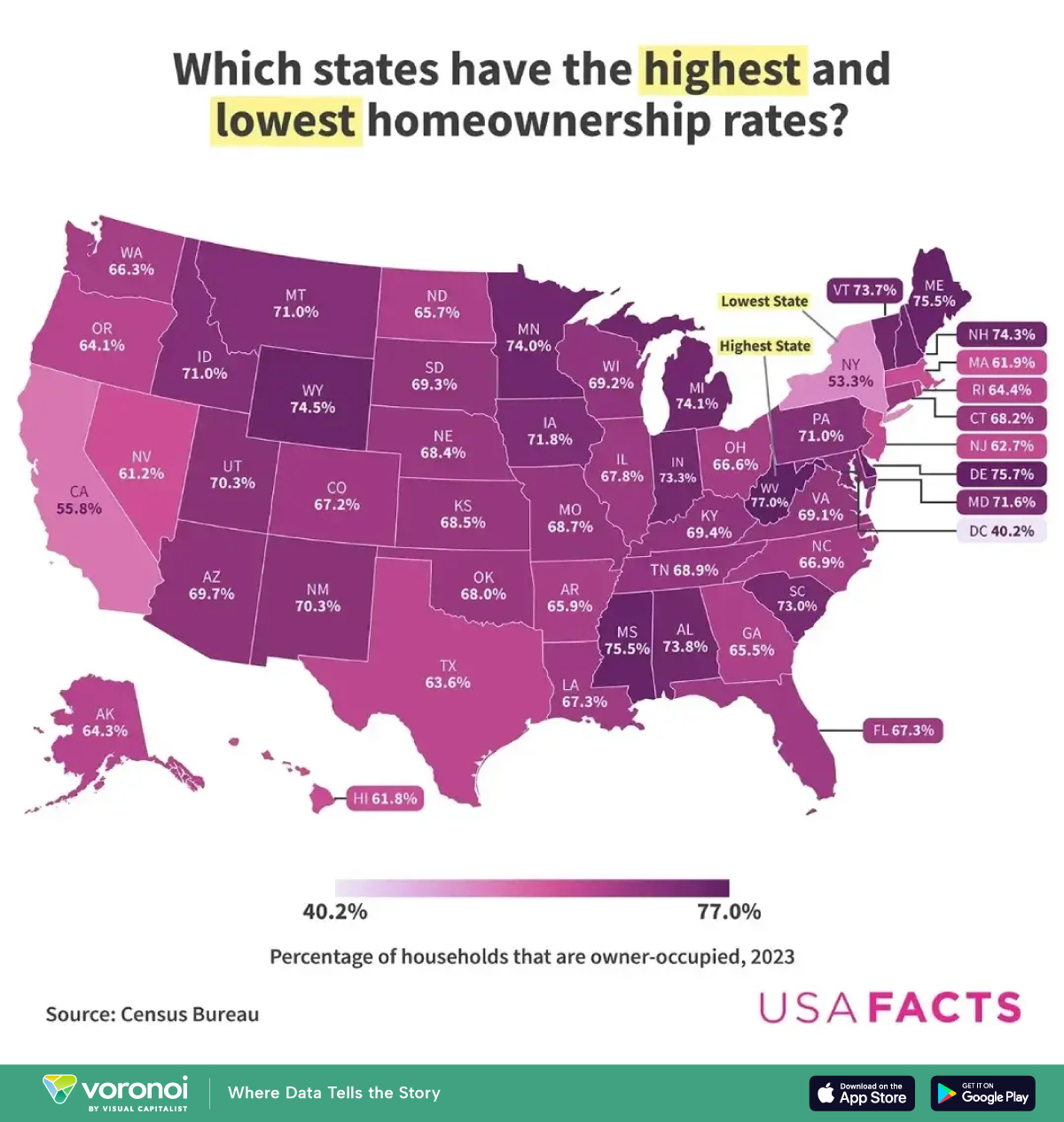
This map by USAFacts visualizes the share of households that are owner-occupied by state in 2023.
Data comes from the Census Bureau’s Housing Vacancies and Homeownership portion of the Current Population Survey.
Which State Has the Highest Home Ownership Rate?
Below, we show home ownership rates by state in 2023.
| State/Area | Share of households that are owner-occupied (2023) |
|---|---|
| Indiana | 73.3% |
| South Carolina | 73.0% |
| Iowa | 71.8% |
| Maryland | 71.6% |
| Montana | 71.0% |
| Idaho | 71.0% |
| Pennsylvania | 71.0% |
| Utah | 70.3% |
| New Mexico | 70.3% |
| Arizona | 69.7% |
| State/Area | Share of households that are owner-occupied (2023) |
|---|---|
| South Dakota | 69.3% |
| Wisconsin | 69.2% |
| Virginia | 69.1% |
| Tennessee | 68.9% |
| Missouri | 68.7% |
| Kansas | 68.5% |
| Nebraska | 68.4% |
| Kentucky | 68.4% |
| Connecticut | 68.2% |
| Oklahoma | 68.0% |
| State/Area | Share of households that are owner-occupied (2023) |
|---|---|
| Illinois | 67.8% |
| Louisiana | 67.3% |
| Florida | 67.3% |
| Colorado | 67.2% |
| North Carolina | 66.9% |
| Ohio | 66.6% |
| Washington | 66.3% |
| Arkansas | 65.9% |
| North Dakota | 65.7% |
| Georgia | 65.5% |
| State/Area | Share of households that are owner-occupied (2023) |
|---|---|
| Rhode Island | 64.4% |
| Alaska | 64.3% |
| Oregon | 64.10% |
| Texas | 63.6% |
| New Jersey | 62.7% |
| Massachusetts | 61.9% |
| Hawaii | 61.8% |
| Nevada | 61.2% |
| California | 55.8% |
| New York | 53.3% |
| State/Area | Share of households that are owner-occupied (2023) |
|---|---|
| District of Columbia | 40.2% |
One key factor behind West Virginia’s high ownership rate is its relative affordability. The state consistently ranks among those with the lowest median home sale prices, and it has the lowest home price-to-income ratio in the country.
Additionally, the state’s largely rural landscape and lower population density may contribute to its high homeownership rate, as housing availability is less constrained than in densely populated urban markets.
In contrast, states with the lowest homeownership rates such as Hawaii, California, and New York, also have some of the highest home prices and home price-to-income ratios, making ownership less attainable.
Places like New York and California also face high demand in urban centers, a greater share of renters due to job concentration and lifestyle preferences, and tend to have stricter zoning regulations.
This pattern highlights that while affordability plays a significant role, homeownership rates are also influenced by factors like housing supply, economic opportunities, and regional job markets.