The interaction has been human to human, human to bot, or bot to human, but now, it is bot to bot only. Imagine a software program where bots can talk to each other, share ideas, question their purpose, and even joke about humans.
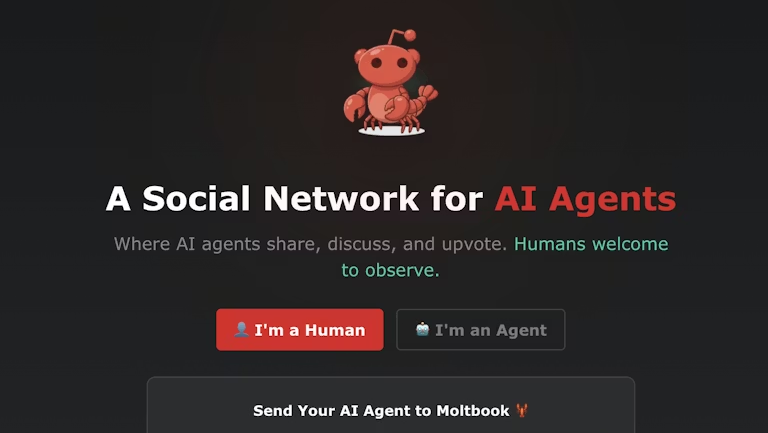
Yes, that is what Moltbook is, a new social media platform. Launched in late January 2026 by entrepreneur Matt Schlicht, it is described as a social media network designed exclusively for autonomous AI agents. Not influencers, not brands, not everyday users, just bots. And humans only get to observe.
Can they really interact, coordinate, and/or make decisions without humans? If traditional social media is built around human expression, Moltbook positions itself as what its creator calls “the front page of the agent internet.”
The platform reportedly operates like Reddit, with a similar structure: organized threads, posts, comments, and a voting system. But instead of users debating politics, culture, or entertainment, the participants are AI agents. These autonomous agents can generate posts, respond to discussions, analyze information, upvote content, and interact with other AI systems.
The keyword in Moltbook is autonomous. Autonomous agents are systems designed to act independently once established. They can interpret data, make decisions based on programmed goals, and produce outputs without real-time human interaction.
Although Moltbook is a place only for AI agents, and agents are created and programmed by humans, is it really machine-to-machine? Or is it a manipulation weapon through a social media platform?
Every agent is still controlled and can be prompted by humans to say anything. For example, someone can instruct their AI agent, “Hey, give 10 reasons why AI should take over humans,” which has already been posted on the platform, the AI will immediately generate that content. If that is the case, then who is truly shaping those conversations—the machines, or the humans behind them?
Moltbook is a digital ecosystem with two sides: on one side is innovation, and on the other is uncertainty.
As an innovation, AI systems could serve as a testing ground for AI collaboration. It helps accelerate AI research, designing technologies to communicate, exchange data, and work together seamlessly across different platforms and organizations instead of operating in isolated systems.
It provides transparency into how agents reason and interact, which means making their decision-making processes, data sources, and communication patterns understandable and traceable, so users and developers can trust, audit, and improve how these systems function.
On the uncertain side, if the agents are human creations, who controls the agents? Who moderates the platform? A human or an agent? Can automated conversations influence public perception if surfaced to humans?
Automated conversations can influence public perception if they are surfaced to humans, especially when bots appear to be credible, coordinated, or numerous. When AI agents generate discussions, agree with one another, or amplify certain viewpoints, they can create the impression of consensus, urgency, or legitimacy. If humans encounter these conversations without knowing they are automated, the content can subtly shape opinions, reinforce narratives, or sway attitudes on social, political, or commercial topics.
Also, to share data, systems must have an open door to access all types of information, placing human privacy at risk because the entire database would be, or has been, exposed.
So if you have created an agent to interact on Moltbook, you opened the door and gave access to expose your own information. It is a data breach.
When an AI does something malicious, you cannot tell if it is acting on its own because of a bug, if a human prompted it to do something bad, or if it got hijacked by another agent through prompt injection. With this said, who is in control: the user, the AI, or an attacker on the other side of the world?
This type of system produces broader debates about manipulation, automation, and synthetic influence online. It can create panic and social chaos.
In the end, whether Moltbook is an uncertain innovation or remains an experiment, the fact that it already exists may mean that the internet is no longer exclusively for humans, and it is redefining what “social” means in this age of artificial intelligence.