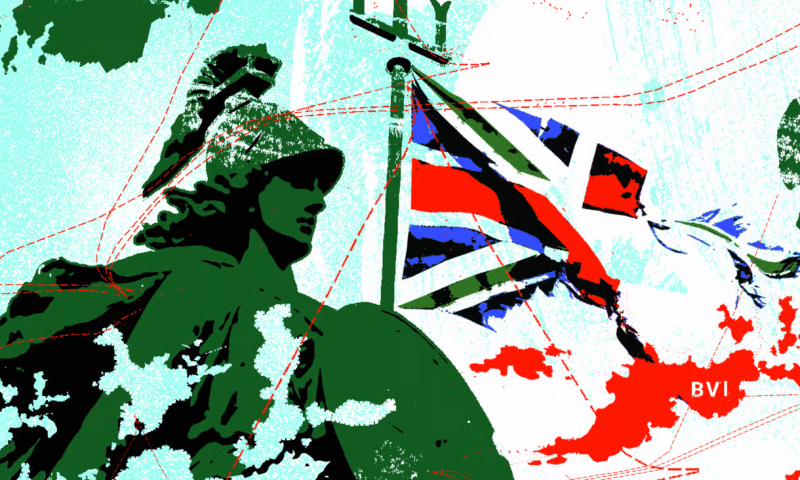
In 2016, the Panama Papers lifted the veil on some of the world’s secrecy havens – not just Panama itself, but other jurisdictions including British territories like Jersey, Guernsey and the British Virgin Islands (BVI).
This article was written by Ed Siddons and originally published by The Bureau Of Investigative Journalism.
The revelation that war criminals, money launderers, corrupt politicians and fraudsters seemed to be seeking out British-flagged jurisdictions alarmed transparency campaigners and, increasingly, lawmakers. British overseas territories came under growing pressure to stamp out the dirty money flowing through their financial systems.
Britain also had to wean itself off the dirty money that had poured into London. That process is still far from complete, but it has nevertheless turned its eyes to the jurisdictions – three Crown dependencies and 14 overseas territories – that still sit under the ultimate rule of King Charles III.
The list of bad actors who have used British overseas territories is long. Teodorin Obiang, the son of the president of Equatorial Guinea, used BVI shell companies to acquire private jets. He was convicted for embezzlement, money laundering and corruption in France in 2017. Rifaat al-Assad, better known as “the butcher of Hama” for his alleged role overseeing the slaughter of tens of thousands of people in Syria in 1982, used Gibraltar shell companies and a Guernsey financial adviser to manage some $300m in stolen Syrian public funds. And the 1MDB scandal, in which billions were looted from Malaysia’s sovereign wealth fund, used BVI and Cayman Islands vehicles to hide the flow of money.
The demand for reforms has met resistance from the territories. Some cried hypocrisy, noting whole swathes of London remain owned by oligarchs and autocrats’ princelings. Other critics highlighted the progress that’s already been made – no small feat, given most of the territories are tiny and have limited resources to comply with the increasingly demanding rules set by the world’s richest economies. Others attacked the arrogance of British overreach in requiring changes in islands that are largely self-governing, without offering a penny to implement them.
The context of resistance is most challenging in the six Caribbean and mid-Atlantic territories: Anguilla, Bermuda, British Virgin Islands, Cayman Islands, Montserrat, and the Turks and Caicos Islands. It’s not lost on residents that Britain’s continuing role in the islands’ governance is a legacy of empire and slavery. Edicts from London can seem like yet another example of a colonial power meddling beyond its authority.
But the overseas territories – and the wrongdoers who infiltrate their financial systems – all know that the union jack brings benefits. The territories are strange political hybrids. They are largely self-governing, with control over welfare, education and all manner of domestic affairs. Foreign affairs, national security and the courts remain under the power of Britain. That has been key to their allure in the globalised, financialised world.
On the one hand, the large degree of autonomy has allowed the territories to craft finance-friendly policies, from lower taxes on income or capital gains to anonymising beneficial owners. But the relationship with London also provides a kind of political and financial underwriting – a sense that if anything were to go wrong, the UK would step in and sort it out. That combination of regulatory freedom and geopolitical stability is a powerful draw for legitimate and illegitimate actors alike.

The connection to Britain – rightly or wrongly – provides a veneer of legitimacy. A large financial transaction may not raise red flags if it comes from the Caymans; but it could do if it came from the Democratic Republic of the Congo. Britain’s reputation for checks and balances, which remains robust across the world, is part of the reason the overseas territories have prospered. Access to the UK’s courts is also invaluable if and when disputes occur.
The UK may be hypocritical in demanding things from the overseas territories that it has only adopted itself far too late. In the case of the Caribbean islands, those demands may well mirror colonial power dynamics, when the lives of residents were controlled by decisions made hundreds of miles away.
But while those financial systems benefit from their affiliation with Britain, MPs and anti-corruption campaigners believe the UK has a right to make demands on cleaning up dirty money. Those demands may not be popular, but that does not mean they are unjustified.