
Americans are increasingly reaching major life milestones later than previous generations, and parenthood is no exception.

This article was written by Dorothy Neufeld and originally published by Visual Capitalist.
While overall U.S. fertility rates have fallen for decades, births among women over 40 are moving in the opposite direction. Rising education levels, delayed marriage, and high housing costs have all contributed to a growing share of women waiting longer to have children.
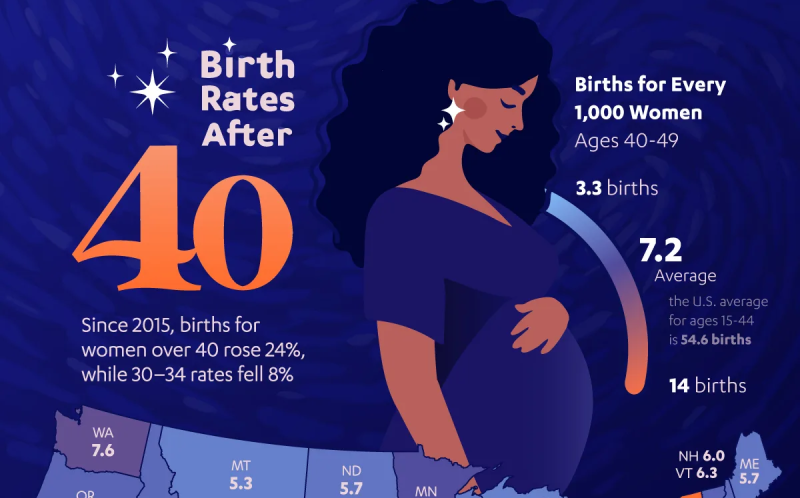
Using newly published research based on National Vital Statistics System data, this map shows where births among women ages 40–49 are most common across the country.
Births After 40 Are Growing Nationwide
For the first time, women over 40 are having more babies than teenagers. Since 1990, the share of U.S. births to women 40 and older has more than tripled, reaching 4.3% in 2025, while birth rates among women ages 40–49 rose 24% over the past decade.
The table below highlights where births among women ages 40–49 were most common in 2024. Washington, D.C., recorded the highest rate in the nation at 13.6 births per 1,000 women, followed by New York, New Jersey, and Hawaii.
|
State
|
Births per 1,000 Women
2015 (Ages 40-49) |
Births per 1,000 Women
2024 (Ages 40-49) |
% Change
|
|---|---|---|---|
| District of Columbia | 13.1 | 13.6 | 4% |
| New York | 8.3 | 10.5 | 27% |
| New Jersey | 7.4 | 9.8 | 32% |
| Hawaii | 8.6 | 9.7 | 13% |
| California | 8.4 | 9.6 | 14% |
| Maryland | 7.0 | 9.2 | 31% |
| Massachusetts | 6.9 | 9.0 | 30% |
| Connecticut | 6.0 | 8.5 | 42% |
| Virginia | 6.3 | 8.0 | 27% |
| Delaware | 5.0 | 7.8 | 56% |
| Alaska | 5.8 | 7.7 | 33% |
| Washington | 6.4 | 7.6 | 19% |
| Florida | 5.8 | 7.5 | 29% |
| Colorado | 6.1 | 7.3 | 20% |
| Minnesota | 5.5 | 7.3 | 33% |
|
State
|
Births per 1,000 Women
2015 (Ages 40-49) |
Births per 1,000 Women
2024 (Ages 40-49) |
% Change
|
|---|---|---|---|
| Rhode Island | 5.2 | 7.2 | 38% |
| Illinois | 6.0 | 6.9 | 15% |
| Texas | 5.9 | 6.8 | 15% |
| Georgia | 5.3 | 6.5 | 23% |
| Nebraska | 5.5 | 6.5 | 18% |
| Nevada | 6.0 | 6.5 | 8% |
| Utah | 6.4 | 6.5 | 2% |
| Pennsylvania | 4.7 | 6.4 | 36% |
| Oregon | 5.8 | 6.3 | 9% |
| Vermont | 3.7 | 6.3 | 70% |
| North Carolina | 4.6 | 6.2 | 35% |
| Arizona | 5.7 | 6.1 | 7% |
| Idaho | 5.2 | 6.1 | 17% |
| New Hampshire | 4.2 | 6.0 | 43% |
| South Dakota | 4.8 | 5.8 | 21% |
|
State
|
Births per 1,000 Women
2015 (Ages 40-49) |
Births per 1,000 Women
2024 (Ages 40-49) |
% Change
|
|---|---|---|---|
| Maine | 3.5 | 5.7 | 63% |
| North Dakota | 4.5 | 5.7 | 27% |
| South Carolina | 4.1 | 5.7 | 39% |
| Wisconsin | 4.3 | 5.6 | 30% |
| Tennessee | 3.8 | 5.5 | 45% |
| Indiana | 4.0 | 5.4 | 35% |
| Kansas | 4.6 | 5.4 | 17% |
| Iowa | 4.0 | 5.3 | 33% |
| Michigan | 4.2 | 5.3 | 26% |
| Montana | 4.9 | 5.3 | 8% |
| Ohio | 4.0 | 5.2 | 30% |
| New Mexico | 4.3 | 5.1 | 19% |
| Louisiana | 3.9 | 5.0 | 28% |
| Missouri | 3.7 | 4.9 | 32% |
| Kentucky | 3.4 | 4.6 | 35% |
|
State
|
Births per 1,000 Women
2015 (Ages 40-49) |
Births per 1,000 Women
2024 (Ages 40-49) |
% Change
|
|---|---|---|---|
| Alabama | 3.1 | 4.5 | 45% |
| Oklahoma | 4.0 | 4.5 | 13% |
| Wyoming | 4.4 | 4.5 | 2% |
| Arkansas | 3.3 | 4.3 | 30% |
| Mississippi | 2.8 | 3.8 | 36% |
| West Virginia | 2.9 | 3.3 | 14% |
Many of the highest-ranking states are both highly educated and expensive, with steep housing costs increasingly delaying homeownership and parenthood.
By contrast, Southern states account for seven of the 10 lowest birth rates among women in their 40s, including West Virginia, Mississippi, and Arkansas. Still, most have seen double-digit growth since 2015, highlighting how later parenthood is rising even in lower-rate states.
How Education Is Reshaping America’s Birth Rates
The average age of first-time mothers reached a record 27.5 years in 2023, rising from 21 in 1972.
Compared with previous decades, Americans are also spending more years in higher education. With more time spent attaining degrees and advancing their careers, women are increasingly deferring childbirth into their 30s and 40s.
Researchers have also found that older parents often bring greater financial resources. Studies suggest that children of older mothers perform better on math and behavioral assessments, largely due to higher levels of parental education and income rather than age itself.
Later Parenthood Is Becoming More Visible
Births after 40 remain uncommon compared with women in their 20s or 30s. Yet their rapid growth highlights how much the timeline of adulthood has changed.
Previous generations often married, purchased homes, and started families in their 20s. Today, many Americans spend longer pursuing education, building careers, and saving for housing before reaching those milestones.
As those timelines shift, later parenthood is becoming a more visible part of the American family landscape.