The Australian government has released the 2022 edition of its Consumer Survey on Online Copyright Infringement. At 159 pages it’s a big read, but in the spirit of showman P.T. Barnum, it has something for everyone. Almost 90% of the most dedicated Aussie consumers obtain content strictly legally, but it can also be argued that 40% of the population are pirates.

This article was written by Andy Maxwell and originally published by Torrent Freak.
The Australian Government has commissioned these surveys since 2015, with the goal of understanding internet users’ consumption habits related to several core content types: music, video games, movies, TV shows and live sports, with the latter appearing more recently in 2019.
The 2022 Consumer Copyright Infringement Survey was conducted online from 24 June to 14 July 2022 and sought responses from internet users aged 12+ regarding their consumption habits in the preceding three months. Overall, 72% of respondents said they consumed content from at least one of the categories.
Overall Consumption and Legality
Consumption of content online increased in 2022 over the figures reported the previous year. TV shows were consumed by 57% of respondents in 2021, with 60% reporting doing so in 2022. An identical three-point increase was observed in the consumption of movies (53% in 2021 / 57% in 2022) and music (45% in 2021 / 48% in 2022).
Video game consumption leaped from 26% in 2021 to 37% in 2022, with live sports reaching 34% in 2022, up from 26% recorded the previous year.
Rather than expecting respondents to determine the legality of their consumption methods, methods were classified as either ‘likely to be lawful’ or ‘likely to be unlawful’ in advance. This allowed respondents to point out the methods used, without discussing legality in depth.
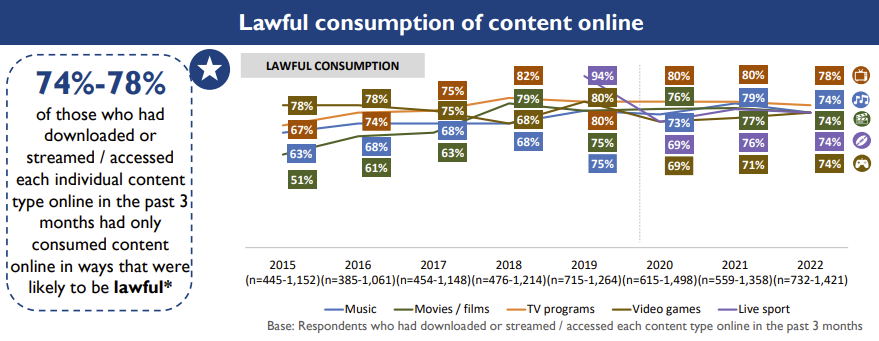
At its most basic level, the term ‘infringer’ in the report identifies a respondent who “reported consuming any content in a way that was likely to be unlawful.” Couple that with respondents who consume content from fewer categories, and Australia suddenly has a problem to solve.
Significant Infringement Increase
The study identifies a ‘non-infringer’ as a respondent who exclusively consumed content from sources predetermined as ‘likely to be lawful’. A single instance of infringement renders a non-infringer an infringer, but in this case, no amount of consumption from legal sources can redeem an infringer.
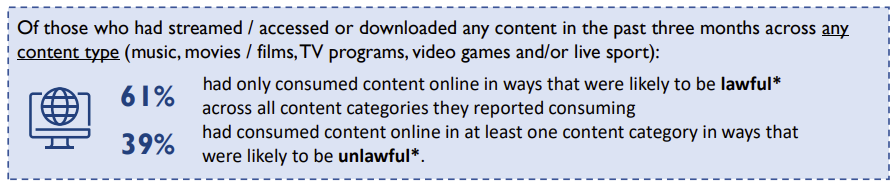
As result, when the survey balances those who streamed or downloaded any content in the previous three months across any of the content types (music, movies, TV shows, video games, and/or live sports), the picture becomes more gloomy.
Credential Sharing
New unlawful methods of consumption are a feature of a continuously developing piracy landscape. In an effort to keep up with these emerging trends, the 2022 survey considered respondents who “pay a small fee to access one or many subscription services through a shared / unknown account (e.g. shared login credentials).”
Most people understand the concept of password sharing; a friend or family member shares their Netflix password, for example, so that the other person doesn’t have to pay. It’s the most common type of credential sharing for that very reason – it’s free.
By including “pay a small fee”, the category might be targeting people who share accounts with others for a fee, but then that misses the overwhelming majority who don’t. That leaves hacked/stolen accounts or conceivably subscription IPTV services, but as a paid piracy option, IPTV doesn’t appear in a distinct category of its own.
Despite the potential for confusion, 11% of all respondents said they had paid a small fee to access one or many subscription services through a shared or unknown account.

Site Blocking Measures
Site blocking doesn’t appear to bother pirates too much in Australia, possibly because the general public has seen it all before. After being denied timely access to legal movies and TV shows for many years, Australians turned to VPNs to ‘unblock’ access to overseas content.
According to this year’s study, 17% of consumers encountered a blocked site in the previous three months. Six out of ten “simply gave up” trying to access any content at all, a figure directly in line with last year’s survey.
Of the remainder, 16% bypassed the block, 14% sought alternative lawful access, while 6% attempted to obtain the same content for free from other illegal sources.
Pirate Blocking Countermeasures
Those who bypassed website blocks used various tools. With 46% overall, VPNs came out on top but still fell short of the 61% who used them in 2021. Just 6% used a custom DNS but nearly a quarter of respondents (23%) said they were aware of them.
Almost a quarter (24%) used some kind of proxy website, versus 21% in 2021. Nearly one-fifth (18%) say they used a search engine to find an alternative site, while 15% used Google Translate as a workaround.

For the optimistic, roughly three-quarters of the most dedicated consumers of content in all categories never pirate anything. Of the remainder, the majority are buying something, meaning they can be encouraged to buy more.
Even the estimates relating to fewer content categories aren’t that bad. When 61% of consumers exclusively use legal content and 39% are reported as having obtained pirated content once or more, that doesn’t mean 39% pirate everything.
“Within content types, no more than 12% of all respondents use only unlawful methods to access content and just 3% of all respondents use only unlawful consumption methods across all content types they consume,” the report reveals.
Or as the Australian government frames it: “Research conducted for the Attorney-General’s Department has revealed the rate of Australians accessing online content unlawfully remains disturbingly high.”