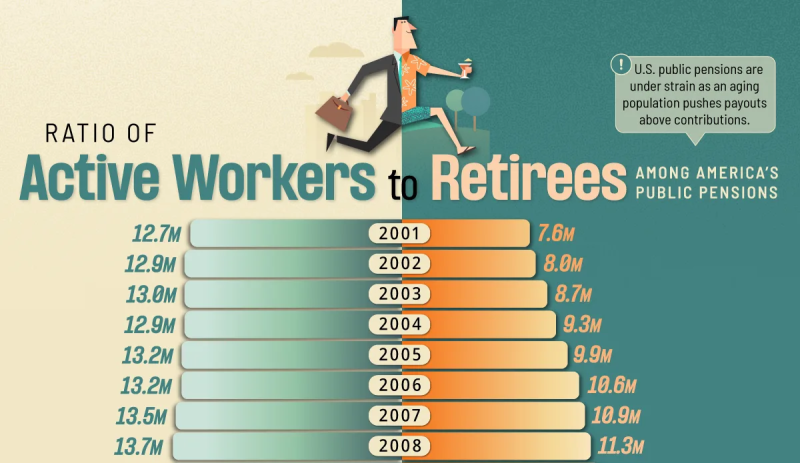
In 2012, America’s public pension system reached a demographic tipping point: retirees began to outnumber the active workers funding them.
This article was written by Marcus Lu and originally published by the Visual Capitalist.

More than a decade later, that reversal remains in place. As Americans live longer and public workforce growth slows, pension systems are paying out more in benefits than they collect from contributors, increasing their reliance on investment returns to stay funded.
This visualization, using data from the Equable Institute, tracks the number of active public employees contributing to pension systems versus retirees receiving benefits from 2001 to 2024.
2012: A Historic Turning Point
In 2001, there were 12.7 million active workers supporting 7.6 million retirees. However, by 2012, retirees (13.3 million) surpassed active workers (13.2 million).
Since then, the gap has widened. By 2023, there were 19.5 million retirees compared to 13.7 million active workers. Although 2024 shows a modest rebound in active workers to 14.5 million, retirees still significantly outnumber contributors.
|
Year
|
Active Workers (Millions)
|
Retirees (Millions)
|
|---|---|---|
| 2001 | 12.7 | 7.6 |
| 2002 | 12.9 | 8.0 |
| 2003 | 13.0 | 8.7 |
| 2004 | 12.9 | 9.3 |
| 2005 | 13.2 | 9.9 |
| 2006 | 13.2 | 10.6 |
| 2007 | 13.5 | 10.9 |
| 2008 | 13.7 | 11.3 |
| 2009 | 13.7 | 11.8 |
| 2010 | 13.7 | 12.3 |
| 2011 | 13.4 | 12.7 |
| 2012 | 13.2 | 13.3 |
| 2013 | 13.0 | 13.9 |
|
Year
|
Active Workers (Millions)
|
Retirees (Millions)
|
|---|---|---|
| 2014 | 13.1 | 14.3 |
| 2015 | 13.3 | 14.7 |
| 2016 | 13.3 | 15.3 |
| 2017 | 13.6 | 15.5 |
| 2018 | 13.5 | 16.3 |
| 2019 | 13.2 | 16.6 |
| 2020 | 13.5 | 16.6 |
| 2021 | 13.1 | 17.6 |
| 2022 | 13.4 | 18.8 |
| 2023 | 13.7 | 19.5 |
Why the Worker-to-Retiree Ratio Matters
Pension systems rely on three main funding sources: employee contributions, employer contributions, and investment income. When active workers decline relative to retirees, contribution inflows shrink while benefit payments rise.
This creates a funding gap: benefit payments exceed contributions from active workers. To cover the difference, pension funds must rely more heavily on investment returns, increasing exposure to market volatility.
Longer Lives, Greater Pressure
Longer retirements mean benefits are paid out for more years per beneficiary. At the same time, slower public workforce growth limits the base of contributors supporting those payments. Even strong investment years may not fully offset this structural shift.
For policymakers, the challenge is balancing sustainability with benefit security. Options often include contribution adjustments, benefit reforms, or changes to investment strategies.
The growing retiree population reflects broader aging trends across the U.S., which are reshaping public finances at both the state and local level.