Image Courtesy Of Real Investment Advice
Hiking rates into a wildly overvalued market is potentially a mistake. So says Bank of America in a recent article.
Optimists expecting the stock market to weather the rate-hike cycle as they’ve done in the past are missing one important detail, according to Bank of America Corp.’s strategists.
While U.S. equities saw positive returns during previous periods of rate increases, the key risk this time round is that the Federal Reserve will be “tightening into an overvalued market,” the strategists led by Savita Subramanian wrote in a note.
“The S&P 500 is more expensive ahead of the first rate hike than any other cycle besides 1999-00,” they said.” – Yahoo Finance
This article was written by Lance Roberts and originally published by Real Investment Advice.
While many media experts suggest that investors should not be concerned about rate hikes, BofA makes a very valid point regarding valuations.
Before we get there, we need to review current valuation levels and how we got here.
Valuations are a function of three components:
The price-to-earnings ratio, or the P/E ratio, is the most common visual representation of valuations. However, we tend to forget that ” psychology ” drives investors to overpay for those future earnings.
In other words, while valuations, in the long run, reflect future returns, in the short run, they reflect investor sentiment.
So, back to BofA, how could hiking rates now be problematic for stocks?
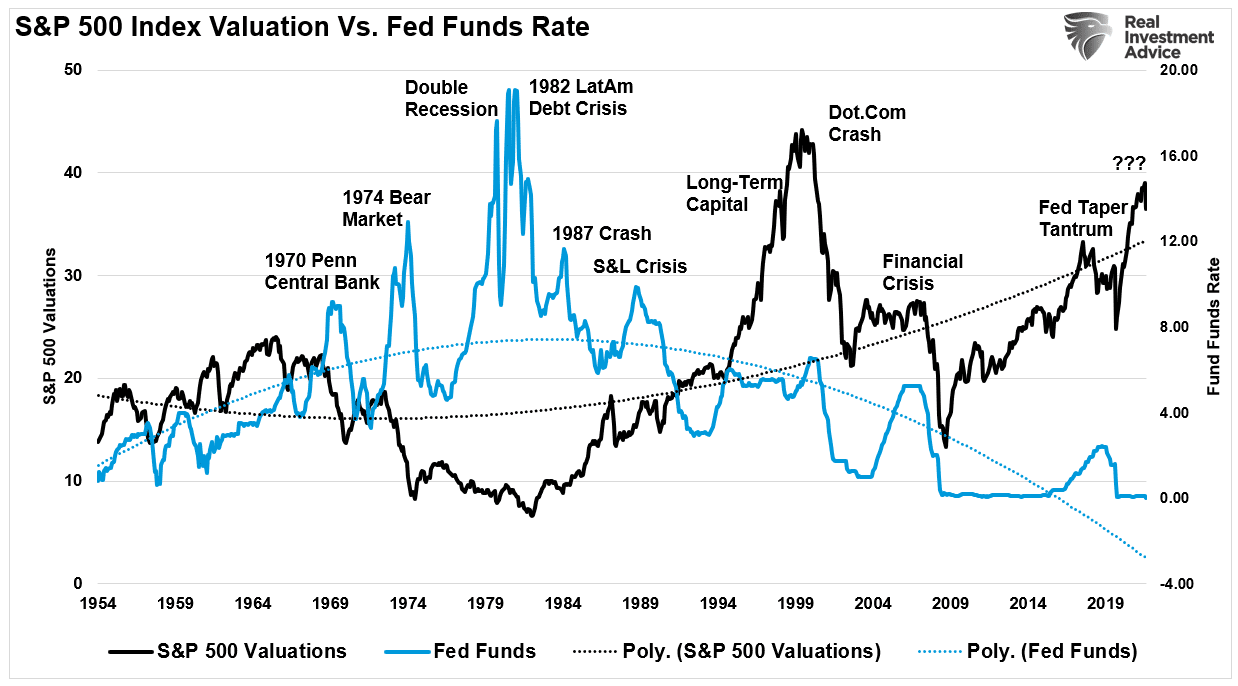
Historical Valuations And Fed Hikes
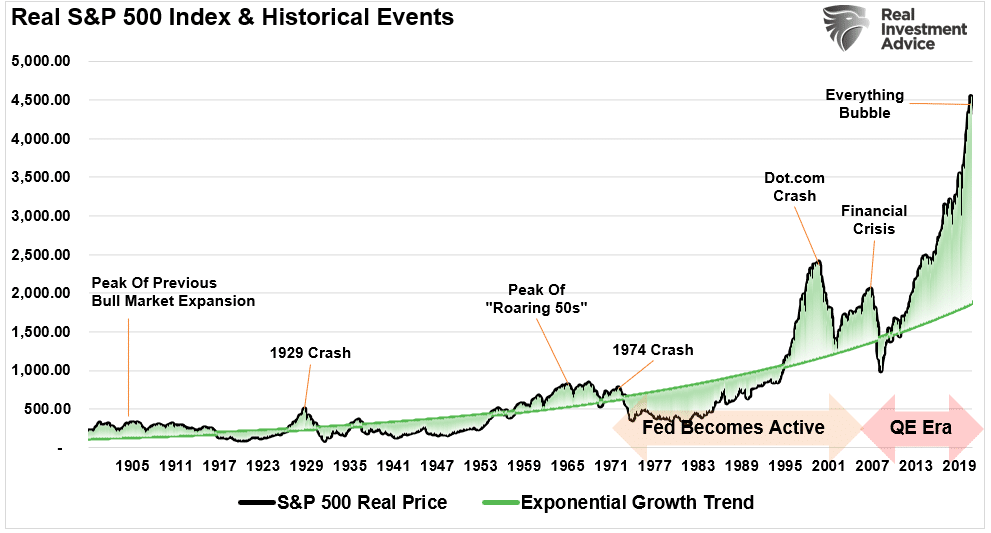
We recently discussed the massive deviation from long-term growth trends for the S&P 500. To wit:
Over the last 12-years, the pace of price increases accelerated due to massive fiscal and monetary interventions, extremely low borrowing costs, and unrelenting “corporate buybacks.” As shown, the deviation from the exponential growth trend is so extreme it dwarfs the “dot.com” era bubble.
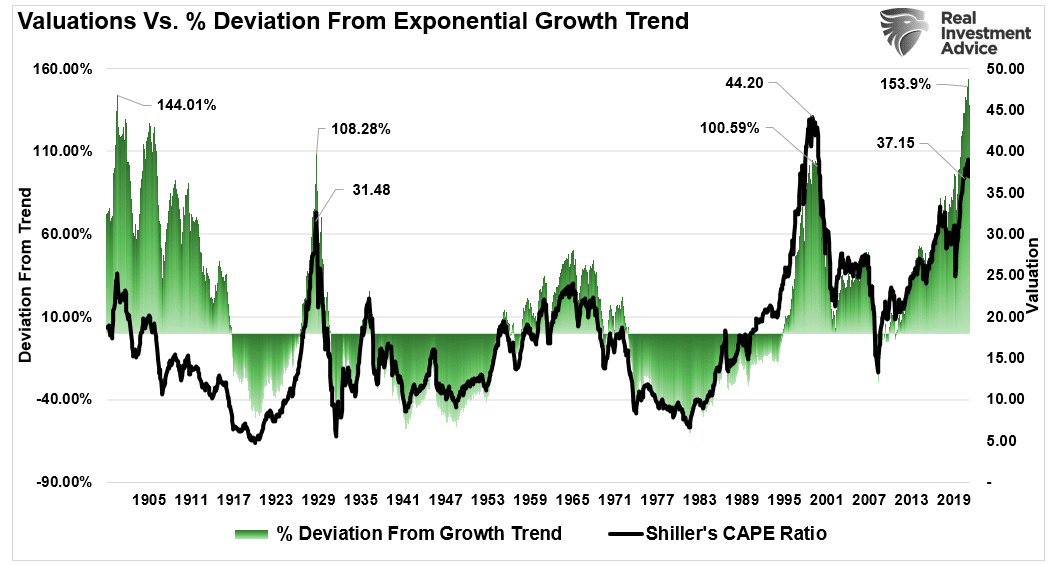
That massive flood of liquidity from the Government checks to households, the Fed’s zero-interest-rate policy, and $120 billion in monthly bond purchases had to go somewhere. Instead, it showed up as inflation in both prices of goods and services and financial assets. Currently, market valuations are more extended than at any other point in history other than the “Dot.com” bubble.
Realigning the data above, we see that valuation extremes are a function of price extremes.
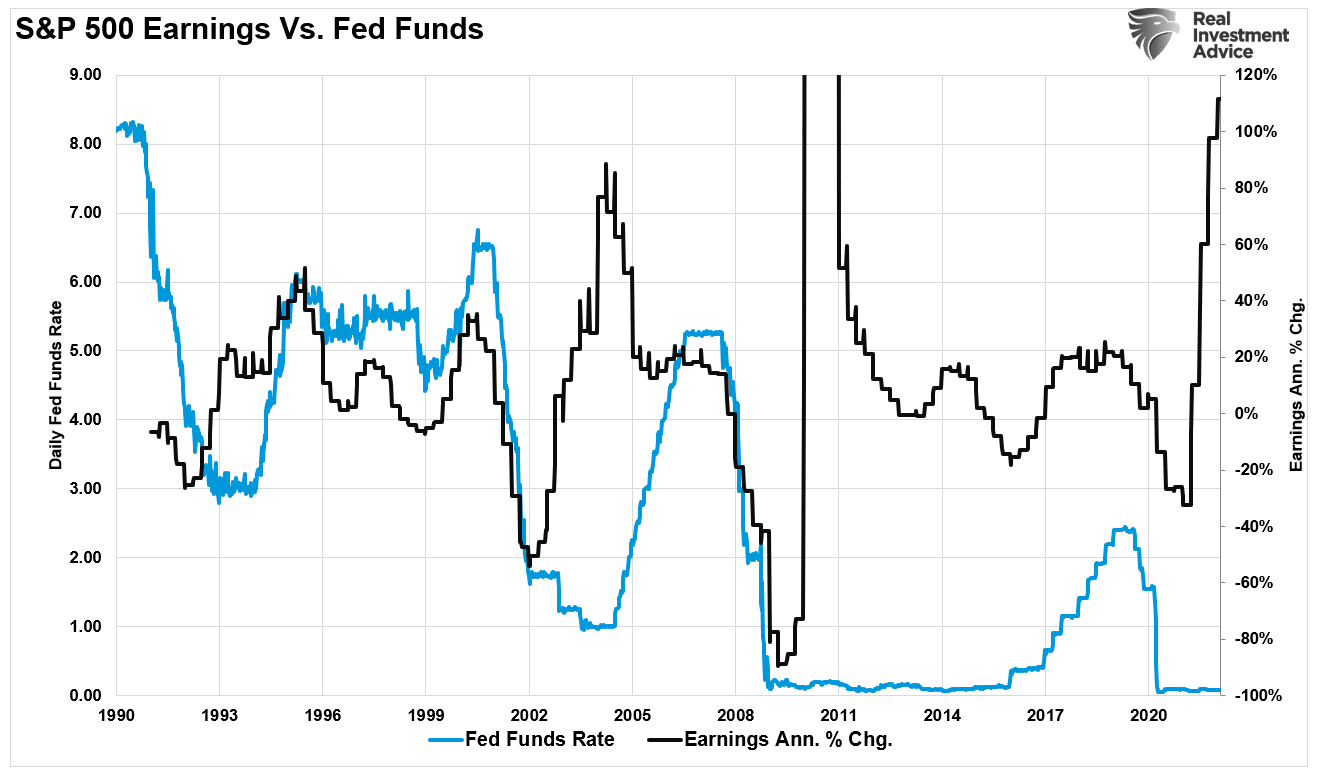
Investors chase stocks on expectations of continued economic and earnings growth, so they risk disappointment. When the Fed tightens monetary policy to slow economic growth and quell inflation, such leads to a reversal in earnings.
Given already high valuations, the outcome will not be what investors were told to expect.
The Problem Of High Valuations And Forward Returns
For investors, the primary bullish arguments for overpaying for valuation over the last decade was three-fold:
The premise was that with the Fed keeping rates at zero and earnings growth, the present value of future cash flows from equities would rise enough to justify their valuation. Furthermore, the Fed supporting asset prices with massive rounds of Quantitative Easing (QE) investment risk got removed. While true, assuming all else is equal, a falling discount rate does suggest a higher valuation.
“Instead of regarding stocks as a fixed-rate bond with known nominal coupons, one must think of stocks as a floating-rate bond whose coupons will float with nominal earnings growth. In this analogy, the stock market’s P/E is like the price of a floating-rate bond. In most cases, despite moves in interest rates, the price of a floating-rate bond changes little, and likewise the rational P/E for the stock market moves little.” – Cliff Asness
As Cliff notes, zero-interest rates and rising earnings growth supports high valuations. However, if earnings growth is declining as the Fed is hiking rates, such would logically denote lower future valuations. In this instance, to have a lower P/E ratio, as the (E) is declining, the (P) must also decrease.
Simply, if low-interest rates are bullish for equities, then higher rates can not be. They can’t be both.
Financial history confirms the logic.
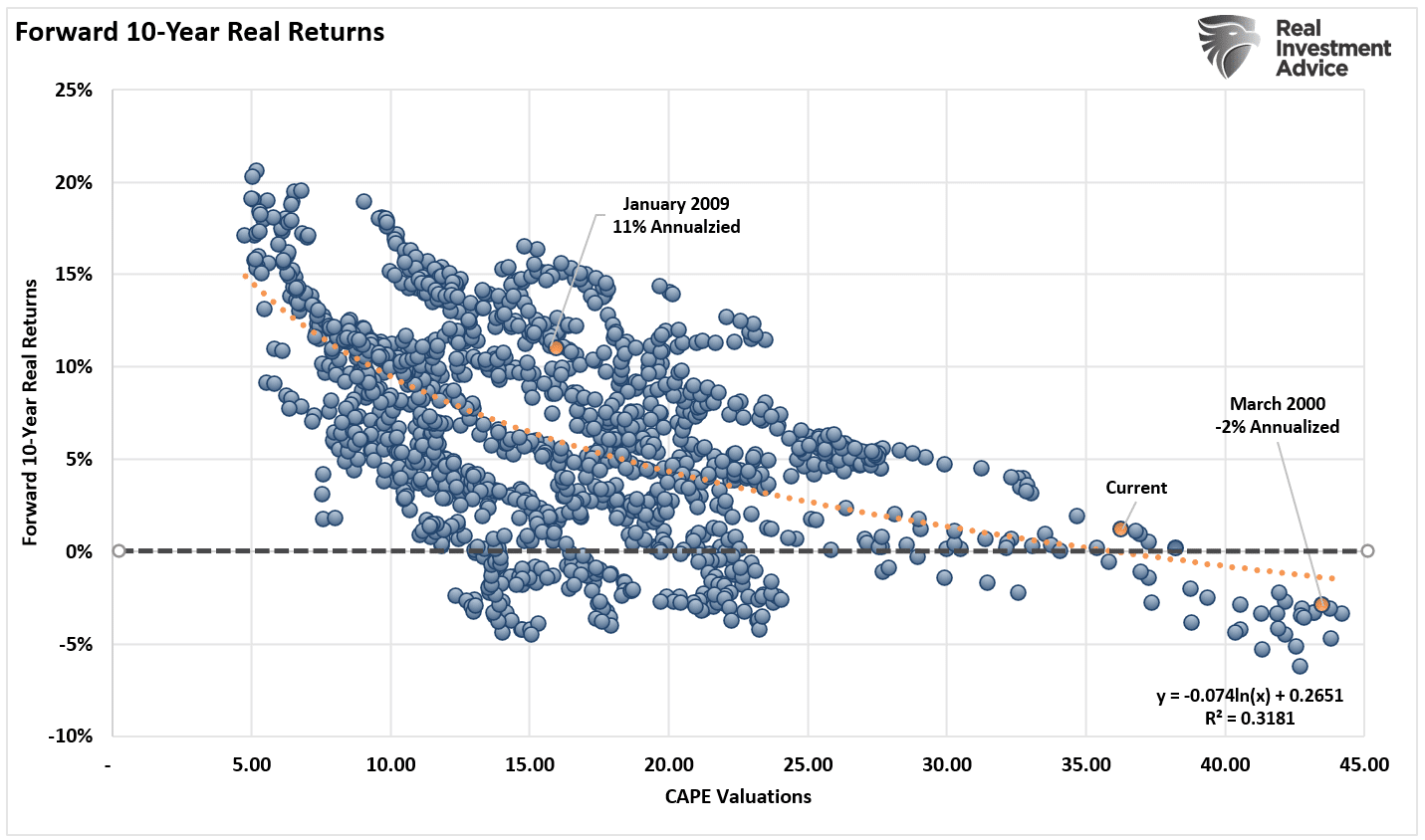
As we already know, high valuations lead to low future returns, as noted by 120-years of data. (Data courtesy of Dr. Robert Shiller)
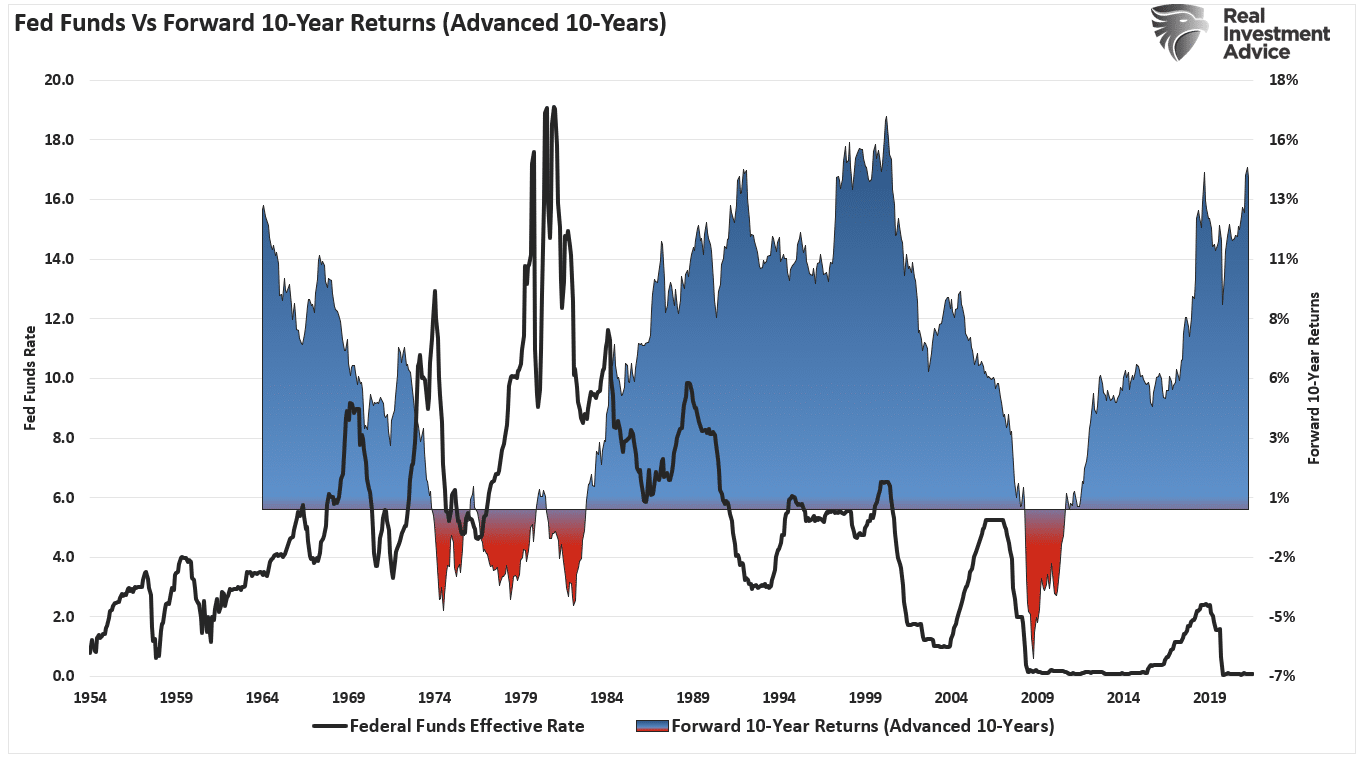
However, logic and data also show that future returns decline when the Federal Reserve hikes rates, particularly in combination with elevated valuations.
This Time Is Unlikely Different
While market analysts continue to develop a variety of rationalizations to justify high valuations, none of them hold up under objective scrutiny. As noted previously:
“The problem is while Central Bank interventions boost asset prices in the short-term, over the long-term there is an inherently negative impact on economic growth. As such, it leads to the repetitive cycle of monetary policy.
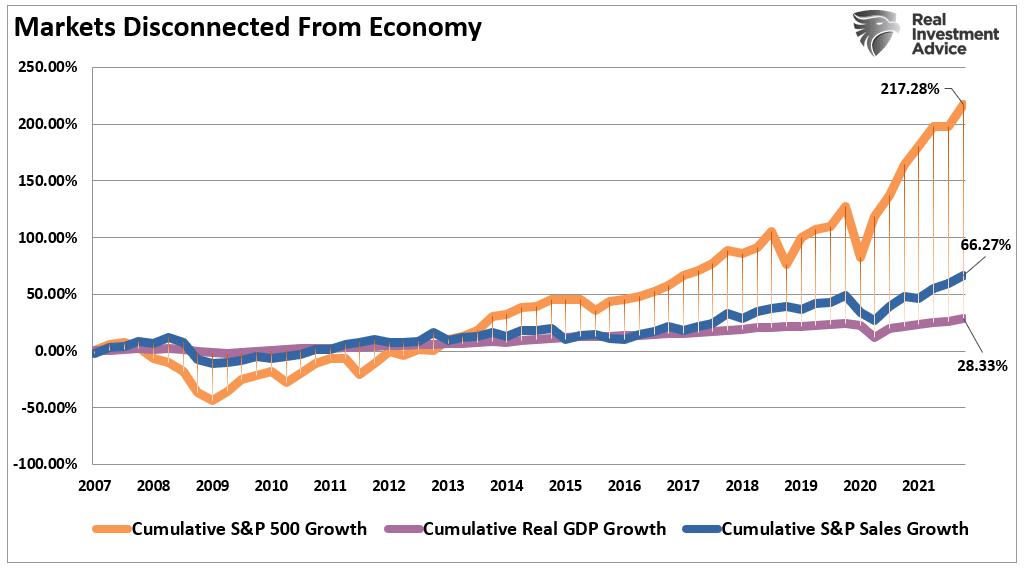
If you don’t believe me, here is the evidence.
“Through the end of Q2-2021, using quarterly data, the stock market has returned almost 217% from the 2007 peak. Such is more than 7.5x the GDP growth and 3.2x the increase in corporate revenue. (I have used SALES growth in the chart below as it is what happens at the top line of income statements and is not AS subject to manipulation.)“
While it is “bullish” to come up with reasons to justify overpaying for assets in the short term, “fighting the Fed” is generally a “no-win” situation.
That means if a massive flood of liquidity, QE, and zero rates was your thesis for overpaying for earnings previously, the reversal of that policy is not.
You don’t get to have it both ways.
Ownership of AI and control of personal data are no longer abstract questions for techies… Read More
Faith institutions already own land and want to help address community needs — can this… Read More
The U.S. economy grew 2.1% in real terms in 2025, but that national figure tells… Read More
Much of the concern surrounding artificial intelligence is about power: the technology’s economic power to… Read More
Cuba fully restored its energy grid early Wednesday after the third nationwide blackout this year, but… Read More
Up until now, the politicization of AI models generally ran in one direction with US… Read More
This website uses cookies.