Image Courtesy Of The Felder Report
“Even the most circumspect friend of the market would concede that the volume of brokers’ loans—of loans collateraled by the securities purchased on margin—is a good index of the volume of speculation.” -John Kenneth Galbraith, The Great Crash 1929
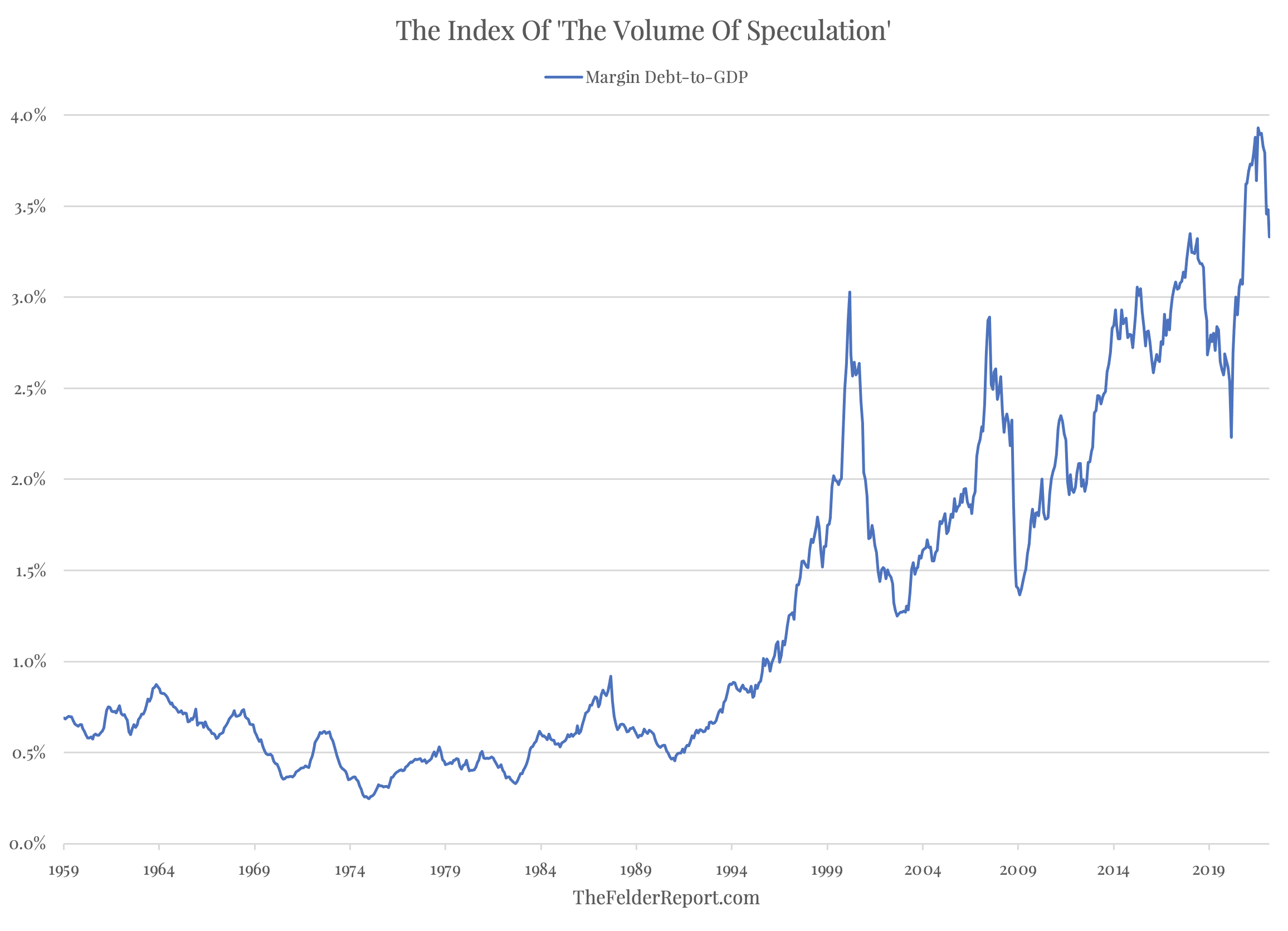
About a year ago, I noted that the “Index of the Volume of Speculation,” also known as margin debt, was in the process of putting in a blowoff top. The absolute level had reached record highs, suggesting that we were witnessing a degree of speculative activity that surpassed anything since the late-1920’s stock market mania Galbraith was specifically referring to in the quote above.
This article was originally published by The Felder Report.
What’s more, it’s important to note that margin debt may be merely representative of a much larger use of leverage in things like asset-backed loans, call options, futures, leveraged ETFs, total return swaps, etc. All told, the total amount of leverage employed in the markets for risk assets may, in fact, be even larger than that earlier, ominous precedent.
As both charts demonstrate, the process of leveraging up has reversed and deleveraging is now underway. And it’s this deleveraging process that is likely responsible, to some degree or another, for the steep stock market declines that normally follow the blow off tops in these episodes. And from the looks of both charts, we haven’t yet come close to a level of deleveraging that indicates the worst is now behind us.
Ownership of AI and control of personal data are no longer abstract questions for techies… Read More
Faith institutions already own land and want to help address community needs — can this… Read More
The U.S. economy grew 2.1% in real terms in 2025, but that national figure tells… Read More
Much of the concern surrounding artificial intelligence is about power: the technology’s economic power to… Read More
Cuba fully restored its energy grid early Wednesday after the third nationwide blackout this year, but… Read More
Up until now, the politicization of AI models generally ran in one direction with US… Read More
This website uses cookies.