
While global public debt is lower than pandemic highs in real terms, it remains stubbornly elevated at $111 trillion.
This article was written by Dorothy Neufeld and originally published by Visual Capitalist.
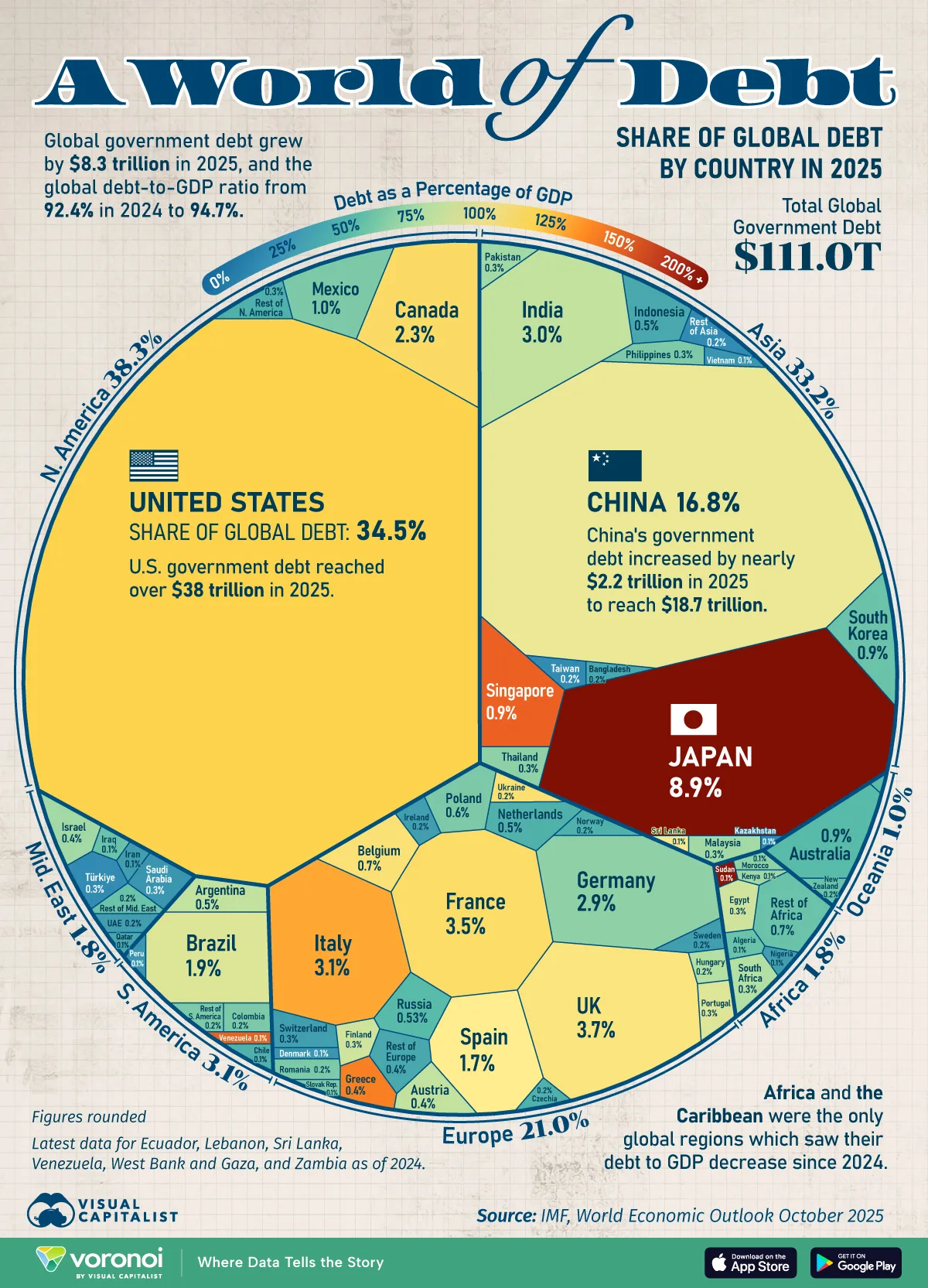
This graphic shows world debt by country in 2025, based on data from the IMF’s latest World Economic Outlook.
A Closer Look at World Debt by Country (Top 10):
|
Country
|
Share of Global Debt
2025 |
Value of Debt
(Billions USD) |
General Government Gross Debt
(Percent of GDP) |
|---|---|---|---|
| 🇺🇸 U.S. | 34.5% | $38,269.7 | 125.0% |
| 🇨🇳 China | 16.8% | $18,680.8 | 96.3% |
| 🇯🇵 Japan | 8.9% | $9,826.5 | 229.6% |
| 🇬🇧 UK | 3.7% | $4,093.4 | 103.4% |
| 🇫🇷 France | 3.5% | $3,916.2 | 116.5% |
| 🇮🇹 Italy | 3.1% | $3,479.8 | 136.8% |
| 🇮🇳 India | 3.0% | $3,357.9 | 81.4% |
| 🇩🇪 Germany | 2.9% | $3,228.7 | 64.4% |
| 🇨🇦 Canada | 2.3% | $2,601.0 | 113.9% |
| 🇧🇷 Brazil | 1.9% | $2,062.8 | 91.4% |
America’s debt burden exceeds $38 trillion in 2025, standing at 125% of GDP.
Over the past five years, net interest payments on the national debt have nearly tripled. They are projected to double again by 2035 to reach $1.8 trillion per year.
With $18.7 trillion in debt, China ranks in second. In 2025, debt expanded by almost $2.2 trillion, driven by government stimulus and weaker land revenues given a struggling property market sector.
As we can see, Japan follows next with a $9.8 trillion debt pile, equal to 230% of GDP. Even though debt remains sky-high, the country’s new prime minister, Sanae Takaichi, is proposing $92.2 billion in stimulus spending and subsidies.
The UK and France round out the top largest debt burdens, both hovering near $4 trillion. France, in particular, has experienced significant political instability amid contentious budget cut proposals, cycling through five prime ministers over the past two years.