Image Courtesy Of Gavin On Unsplash
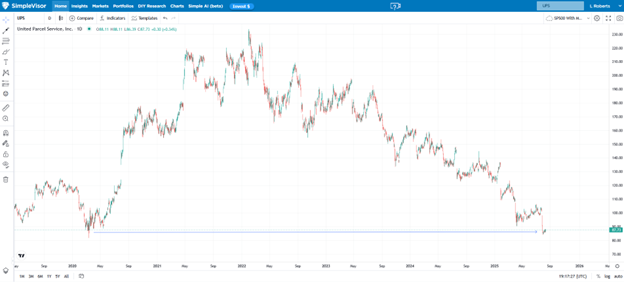
Shares of UPS are around the same price they were in March 2020, when the pandemic shut down economic activity. At the time, the global economy was decimated. In unprecedented fashion, the unemployment rate skyrocketed from 3.5% to 14.8% in one month. While the economic impact was tremendous, there was no relief in sight. The outlook for UPS was horrible, and its stock price reflected it.
This article was written by Michael Lebowitz and originally published by Real Investment Advice.
After a couple of months, the market and economy began to rapidly recover with the help of excessive fiscal and monetary stimulus. Yet, despite the economic recovery since early 2020 and the stock market soaring by over 200% from the Covid lows, UPS shares are at the same price they had when the world was in an economic free fall.
UPS and some other well-known stocks are trading at or near their pandemic lows. Thus, in line with our article, The Low Beta Boom, in which we consider stocks that may outperform when this speculative bull market ends, we assess whether laggards like UPS can protect us.
In the future, we will write similar articles about other larger, well-known companies in situations like UPS. This may allow us to build out a list of stocks that serve us well when the market trends lower.
UPS Valuations
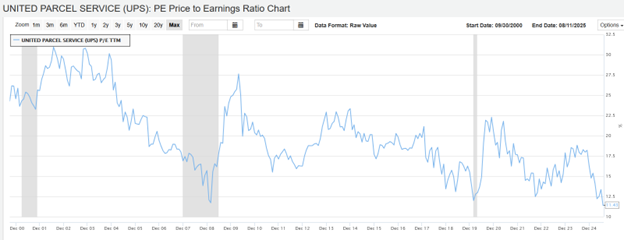
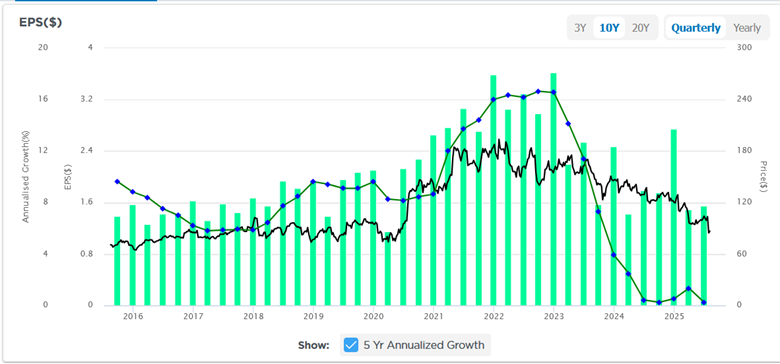
According to some metrics, UPS trades at cheap valuations. For instance, its forward and trailing P/E are 12.00 and 11.50, respectively. As shown below, courtesy of Zacks, its P/E is now slightly below where it was at the trough of the financial crisis and the lowest level since at least 2000.
Similarly, its Price to Sales ratio is 0.81, which is at its lowest level since the financial crisis. For context, the Trailing P/E, Forward P/E, and P/S on the S&P 500 are much more expensive at 29.5, 22.3, and 3.22.
Of importance to us is the PEG ratio. The ratio normalizes valuations by factoring in expected growth rates. According to Zacks, UPS has a PEG ratio of 2.50. Such implies expected earnings per share growth of 4.60%. That compares to a range of 6%-9% pre-Pandemic and a sub 4% growth rate over the last five years.
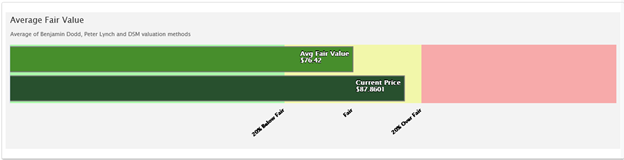
The screenshot below from SimpleVisor uses three discounted cash flow models to calculate a fair value for UPS. Despite the valuations, the stock is still trading about 14% above fair value.
SimpleVisor Top Investor AI Analysis
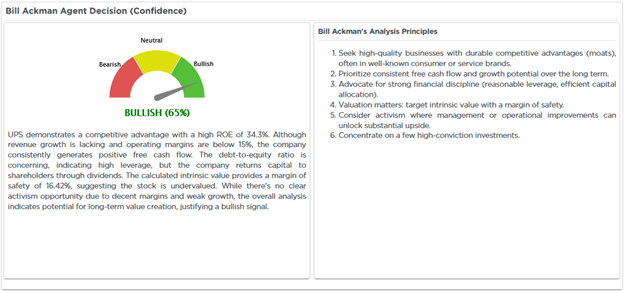
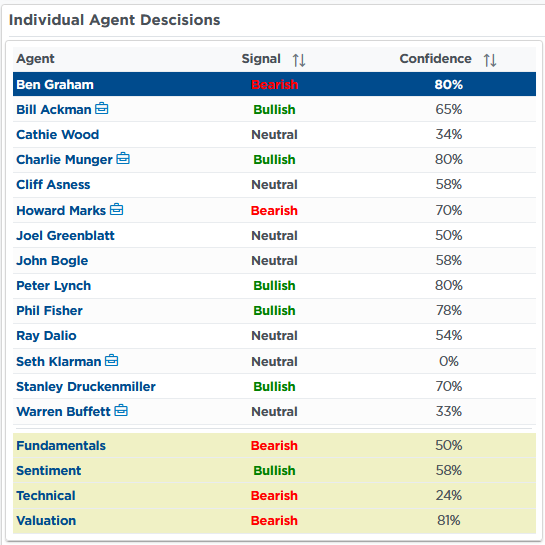
Next, we use our new SimpleVisor AI agent tool to see how a few famed investors may look at the stock. This AI tool uses the investment principles of famed investors (AI agents) to determine whether they would be bullish or bearish on a stock. Furthermore, it assigns a confidence level to that decision.
Below, we share details on how two such agents, Ben Graham and Bill Ackman, might value the stock. We also look for guidance from our factor agents, Valuation, Sentiment, Fundamental, and Technical.
The following are the SimpleVisor definitions of the AI agents:
Ben Graham:
Decidedly bearish for the reasons described below
Bill Ackman:
Decidedly bullish for the reasons described below.
With Graham bearish and Ackman bullish, the table below shows that our other famed investor agents are generally bullish to neutral. However, three of our four non-investor agents are bearish.
With that valuation backdrop, let’s better understand why UPS stock is poorly performing and consider a few factors that may cause it to rebound in the future.
UPS – Explaining The Poor Stock Performance
UPS- Reasons For Optimism
Summary
In our article The Low Beta Boom, we wrote that, in aggregate, the stocks with the highest profitability, cheapest valuations, lowest betas, and smallest market caps well outperformed most stocks and protected investors during the dotcom market bust.
Of these fundamental qualifications, the only factor UPS has is cheap valuations. And, as we write, that is debatable. Concerning the other factors, its beta has stayed around 1.0 for most of the last five years. It has a large market cap of $73 billion, and it has not been particularly profitable.
Despite not meeting three of the four criteria, UPS valuations provide a better margin of safety than many stocks. However, while it may fare better than many stocks, we would want to see improvement in earnings and sales trends before committing UPS to our roster of rainy-day stocks.
The bottom line is that even though the price is at the same levels as when the global economy was shut down in 2020, its loss of market share and weakening margins make the valuation somewhat fair. If they don’t improve their fundamentals, UPS, despite seeming cheap valuations, may likely be a value trap.
If you've lived in Ventura County for several years, you've probably noticed that the community… Read More
The 2026 FIFA World Cup is awarding $655 million in performance prize money, making it the richest… Read More
SpudCell is a big step toward synthetic biology's dream of building life from scratch. Synthetic… Read More
If you knew you were standing inside a stock market bubble, you wouldn’t be standing… Read More
A nationwide credit card outage in Japan disrupted shop payments, rail pass purchases and Mobile… Read More
Defense startup Neros has secured a US Army contract valued at up to $500 million… Read More
This website uses cookies.