Image Courtesy Of ZeroHedge
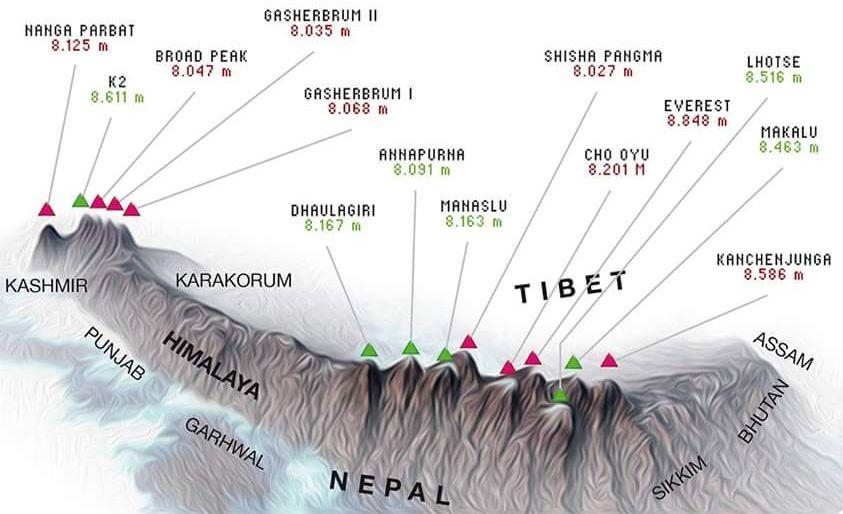
The 14 highest mountain peaks in the world, also known as the eight-thousanders because they are all more than 8,000 meters above sea level, are all distributed in the mountain ranges of the Himalayas and Karakoram.
This article was originally published by ZeroHedge.
They are not only wonders of nature, but magnets for adventurers and extreme athletes. Mount Everest alone, as the highest mountain on earth, attracts hundreds of climbers every year who want to reach the summit.
With today’s equipment, climbing all eight-thousanders is no longer as difficult as it was at the beginning of the 20th century, but, as Statista’s Martin Armstrong details below, such an undertaking should not be taken lightly. As this infographic, inspired by a presentation by data analyst Ervin Vinzon shows, deaths on the eight-thousanders are not uncommon.
You will find more infographics at Statista
According to data from the Himalayan Database and Mountainiq.com, the 8,091-meter main peak of the Annapurna massif is the most dangerous of all mountains.
Since 1900, an estimated 244 expeditions have resulted in 72 deaths – that is, in nearly one in three ascents, one participant did not return. Not infrequently Sherpa, who earn their living with mountain tourism, are also affected. Similarly, the path to the top of the 8,586-meter-high Kangchenjunga is often without return (29.1 percent).
The mountain considered most dangerous among climbers because of its steep passages and constant avalanche danger is K2.
At 8,611 meters, it is the highest mountain in the Karakoram and the second highest of the eight-thousanders after Everest. Data from 2018 show that more than one in five expeditions suffered a fatality.
In absolute numbers, the most people died on Mount Everest, however, it is also the most frequently climbed eight-thousander with over 2,000 expeditions. The death rate on the Qomolangma, as the Tibetans call it, is about 14 percent.
Ownership of AI and control of personal data are no longer abstract questions for techies… Read More
Faith institutions already own land and want to help address community needs — can this… Read More
The U.S. economy grew 2.1% in real terms in 2025, but that national figure tells… Read More
Much of the concern surrounding artificial intelligence is about power: the technology’s economic power to… Read More
Cuba fully restored its energy grid early Wednesday after the third nationwide blackout this year, but… Read More
Up until now, the politicization of AI models generally ran in one direction with US… Read More
This website uses cookies.